

I had everything ready.
My submodalities checklist. A printout of my manual. A clipboard and a pen. I’d even planned roughly when in the session I’d start.
It was one of my first one-to-one clients, a florist I’d met at networking. She had an incredible business. But sitting in those networking meetings, she felt like hers was the least successful in the room.
It wasn’t. It was the most successful in the room. She just couldn’t see it.
She was the perfect person for the limiting belief technique I’d fallen in love with during my training. I couldn’t wait to use it.
So we talked
We sat in a beautiful spot overlooking the water, and I asked questions. About her business. About networking. About how she felt walking into those rooms.
I wasn’t trying to fix anything yet. I was trying to understand one thing: why is this problem a problem — for her? Not how it looked to me. How it looked from inside her model of the world.
Then I noticed the time. Ten minutes left. If I didn’t start the technique now, we’d run over.
So out came the clipboard. “Okay, what’s the limiting belief you told me about at the start?”
She paused.
“It’s gone. I can’t find it any more.”
I tried very hard not to look disappointed about my technique. Because, of course, it was brilliant news. The questions had already done the work.
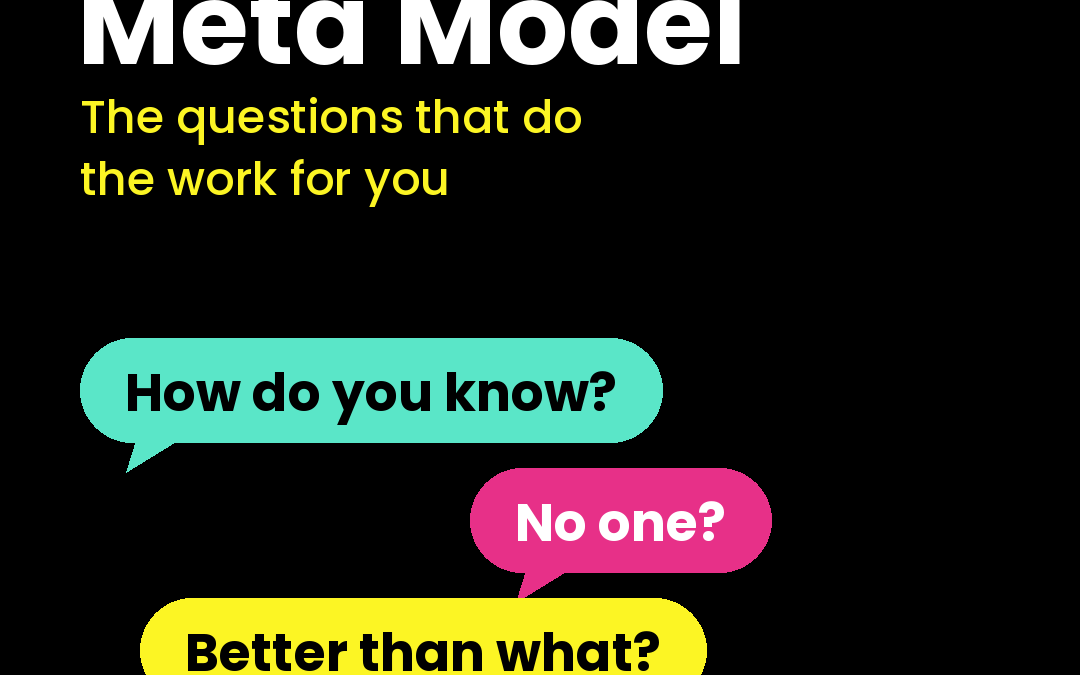
What is the NLP Meta Model?
We all take in what happens around us through our senses. Then without realising we delete some of it, distort some of it and generalise some of it, based on our own model of the world. What’s left becomes our version of reality. And that shapes how we feel, how we act and the results we get.
The Meta Model is a set of questions that help you notice when that’s happened, and gently recover what’s been missed.
If you’ve come across the Milton Model, the Meta Model is its flip side. With the Milton Model, you use deliberately vague language. With the Meta Model, you pick apart the language someone gives you so you understand what they really mean.
The three things to listen for
1. Distortions — when we fill in the gaps.
- “They don’t like me.” → How do you know they don’t like you?
- “They make me happy.” → How does what they do cause you to choose to feel happy?
- “Losing weight means I’ll be happy.” → Have you ever been happy when you weren’t losing weight?
2. Generalisations — when one time becomes every time.
- “No one cares about me.” → No one?
- “I must get this right.” → Or what? What would happen if you didn’t?
- “I can’t live the life I want.” → What prevents you?
3. Deletions — when the detail goes missing.
- “I’m upset.” → About what? About who?
- “She left me.” → How specifically?
- “It’s so much better.” → Better than what?
You don’t need to memorise the names. I tell every student this. What matters is noticing when something’s missing, stretched or twisted, and asking the right question at the right time.
I use it at home, too
My kids are 8 and 11. Between TV, YouTube and magazines, they come home with all sorts of “facts”.
Instead of telling them what to believe, I ask: “Who says?” Then we talk about where it came from and whether it’s a reliable source. They get to decide for themselves.
And when my youngest says someone “made her” react a certain way, I’ll ask how they made her, and what caused her to choose to feel like that. Small word. Big shift.
A word on rapport
Some of these questions are challenging. “How do you choose to feel that way?” can land beautifully with someone you’ve worked with for months, and badly with someone you met ten minutes ago. Build rapport first. And if you’re a coach, mention in your contracting that you might ask some challenging questions.
The one question to ask yourself as a coach
Do I understand why this problem is a problem?
If the answer’s no, ask another question. And another. Let your client do most of the talking, they should always be talking more than you.
When I was training, I loved the techniques and was honestly bored by the language. I didn’t realise how much power was sitting in the questions. Now I know: get the language right, and sometimes you won’t need the technique at all.
Try this today
- Listen for “always”, “never”, “no one”, “they make me”, “I can’t” and “better” — in other people’s words and your own.
- Pick one and get curious: “Always?” “Who says?” “Better than what?”
- Notice what changes when someone has to look for the answer.
The Meta Model is one of the tools we practise live on my NLP Practitioner & Breakthrough Coaching course, alongside the Milton Model, the Hierarchy of Ideas, values and more. If you’d like the details, get in touch and I’ll send them over.

Thinking of deepening your coaching skills? Our intro courses for just £47 are the best place to start!
Life Coach Diploma
Learn the foundations of powerful coaching conversations and how to support others to move forward with clarity and confidence. – CHECK IT OUT
EFT (Emotional Freedom Technique) Training
Discover how tapping techniques can help release emotional blocks and support change quickly and effectively. – CHECK IT OUT
Introduction to NLP
Explore the fundamentals of Neuro-Linguistic Programming and learn how thoughts, language and behaviour patterns shape our results. – CHECK IT OUT
Whether you’re looking to develop professionally, support others, or simply understand yourself on a deeper level, there’s a training that will support you.
👉 We also have deeper, longer and much more in depth courses in NLP and Coaching.
