

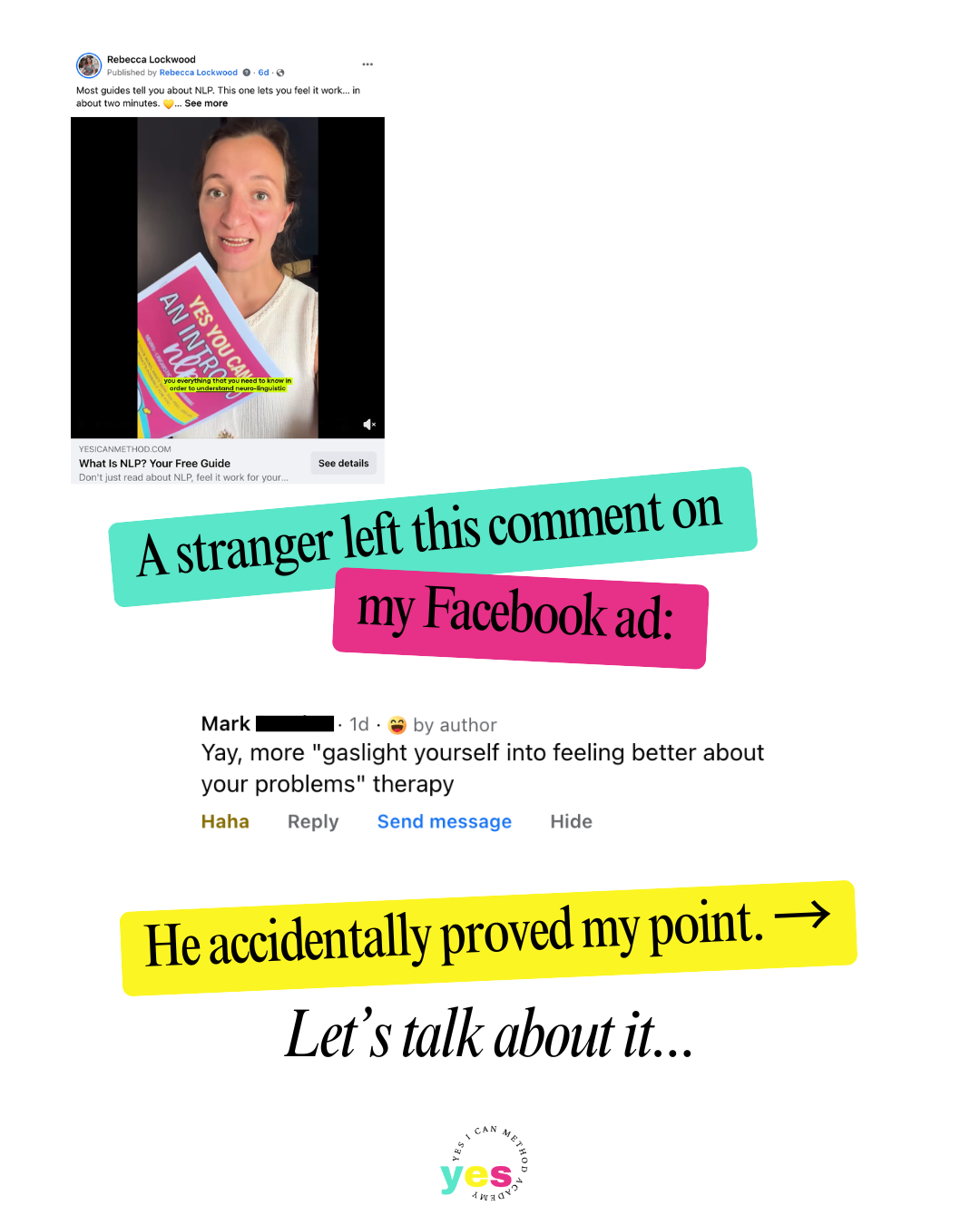






That was the comment.
It landed on one of my Facebook ads, the one for my free NLP guide. Honestly, when I first read it, I laughed:
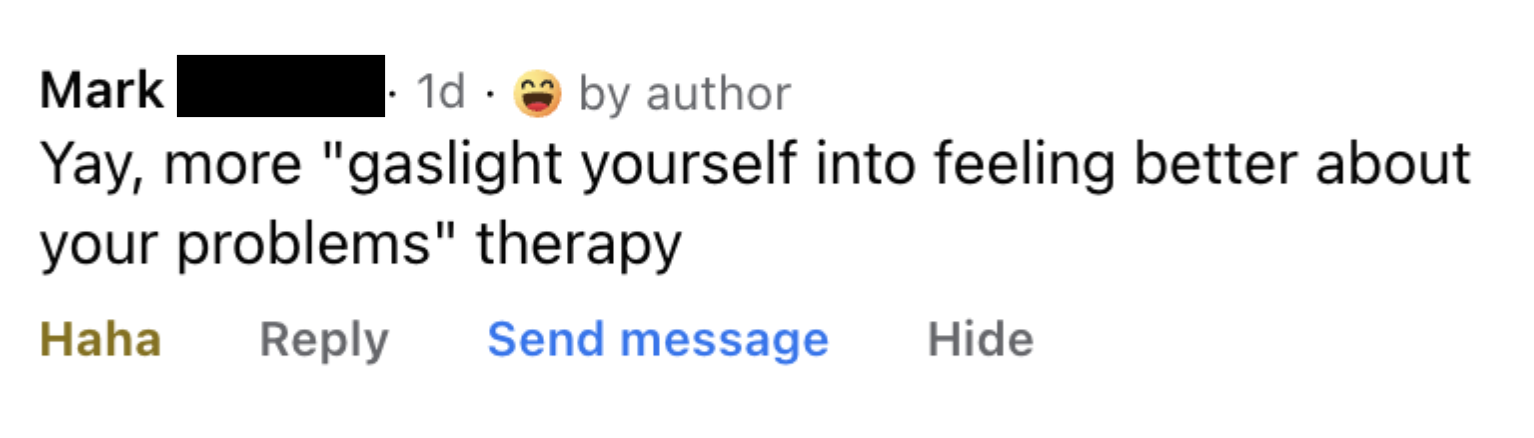
Then I sat with it for a minute. And I realised this guy had accidentally handed me the best explanation of my work I could have asked for.
Because he’s right. Gaslighting yourself into feeling better about your problems is harmful. It doesn’t work. It leaves you worse off than when you started.
The thing is… that’s not NLP. That’s toxic positivity. And they are not the same thing. In fact, they’re opposites.
Let me explain…because I think this is one of the most misunderstood things about the work I do.
What toxic positivity actually is
Toxic positivity is when something goes wrong, or you feel down, or a situation isn’t working out the way you wanted, and instead of acknowledging it for what it is, you brush over it.
You know the phrases. “It’ll all be okay.” “Everything happens for a reason.” “Just stay positive!”
And here’s the important bit: when people say these things to you, they almost always mean well. It comes from love. Whether it’s your mum, your best friend, or a coworker, they’re trying to help. They don’t want to see you hurting.
But it doesn’t help. Because what it actually does is teach you that it’s not okay to feel what you feel. It suggests that your very human emotions are something to skip over rather than honour.
I catch myself doing it with my own kids every now and then, and I always have to pick up my husband on it. They’re eight and eleven now, and when one of them gets upset, my instinct is to say “oh, there’s no need to cry.” I only say it because I love them and I can’t bear to see them upset. But what I’m really teaching them in that moment is: don’t acknowledge how you feel. Push it down. And that is the opposite of what I want for them.
The hot tub holiday (or: the time I cried over a caravan)
Let me tell you a story that still makes me cringe.
A few years ago I booked us a hot tub holiday up in Scotland. I was SO excited, I’d never done one before. I got the kids buzzing about it: “it doesn’t matter if the pool’s closed or everything’s fully booked, because we’ve got our own HOT TUB.”
We got there. No hot tub.
Turns out that when I’d filtered the caravan to allow pets, it had quietly stripped the hot tub off the booking. I’d booked a lovely pet-friendly caravan with precisely zero hot tubs.
I was gutted. Genuinely. I think I actually cried.
And my husband Neil, bless him, looked at me and went: “It’s all right, babe. You teach people about this stuff. You teach people how to stay positive.”
I wanted to poke him in the eye.
Because yes, I do teach this stuff. And that is exactly why I let myself feel completely rubbish about it for the rest of that evening. I was angry, disappointed, frustrated with myself, guilty for building the kids up, then a bit guilty for feeling guilty. I felt all the feels. For about six hours.
And then? The next day I was absolutely fine.
Here’s the part that matters. If I had tried to gaslight myself into being okay, plastered on a smile, told myself “it’s fine, stay positive” I would NOT have been fine the next day. That disappointment would have trailed me round for the whole holiday. Because unfelt emotions don’t disappear. They just wait for you. They are sneaky.
So where does NLP actually come in?
This is the bit the commenter got wrong.
NLP (neuro-linguistic programming) isn’t about pretending you feel fine. Step one is always the opposite: honour how you feel. Feel it. Sit with it. Let yourself be human.
NLP comes in at the next stage, when you’re ready to move through the emotion but you’re finding it hard to. That’s when we bring in tools. Not to bypass the feeling, but to help you process it and find a way forward.
One of my favourite questions to ask is this:
“What can I learn from this situation that is personal, positive, and about my future?”
Notice what that question does not do. It doesn’t say “pretend this didn’t hurt.” It assumes it hurt. It just gently points you toward what’s useful now that you’ve actually felt it.
That’s the whole difference. Toxic positivity skips the feeling. NLP honours the feeling first, then gives you something to do with it.
What to say instead
If someone you love is struggling, you don’t have to fix it with an “it’ll all be okay.” Try:
- “I understand.”
- “Do you want to talk about it?”
- “Is there anything I can do?”
Give them space to feel it. That’s not being negative. That’s being human alongside them.
And if you’re the one struggling? Feel it first. Then, when you’re ready, ask the resourceful question.
So, to the guy on Facebook: thank you. You were right that gaslighting yourself is nonsense. You just aimed it at the wrong target.
If you want the actual tools, the ones that start with honouring how you feel, not bypassing it…that’s exactly what’s inside my free NLP guide. It’s the same work I teach my NLP students, distilled into something you can start using today.
And for some people, that first taste is the beginning of something much bigger, the realisation that this isn’t just something you can feel your way through, it’s something you can learn, and even go on to do for others.

Download the Free Guide to NLP
You’ve Always Sensed You Were Meant for More. This Is Where It Starts.
Thinking of deepening your coaching skills? Our intro courses for just £47 are the best place to start!
Life Coach Diploma
Learn the foundations of powerful coaching conversations and how to support others to move forward with clarity and confidence. – CHECK IT OUT
EFT (Emotional Freedom Technique) Training
Discover how tapping techniques can help release emotional blocks and support change quickly and effectively. – CHECK IT OUT
Introduction to NLP
Explore the fundamentals of Neuro-Linguistic Programming and learn how thoughts, language and behaviour patterns shape our results. – CHECK IT OUT
Whether you’re looking to develop professionally, support others, or simply understand yourself on a deeper level, there’s a training that will support you.
👉 We also have deeper, longer and much more in depth courses in NLP and Coaching.
